
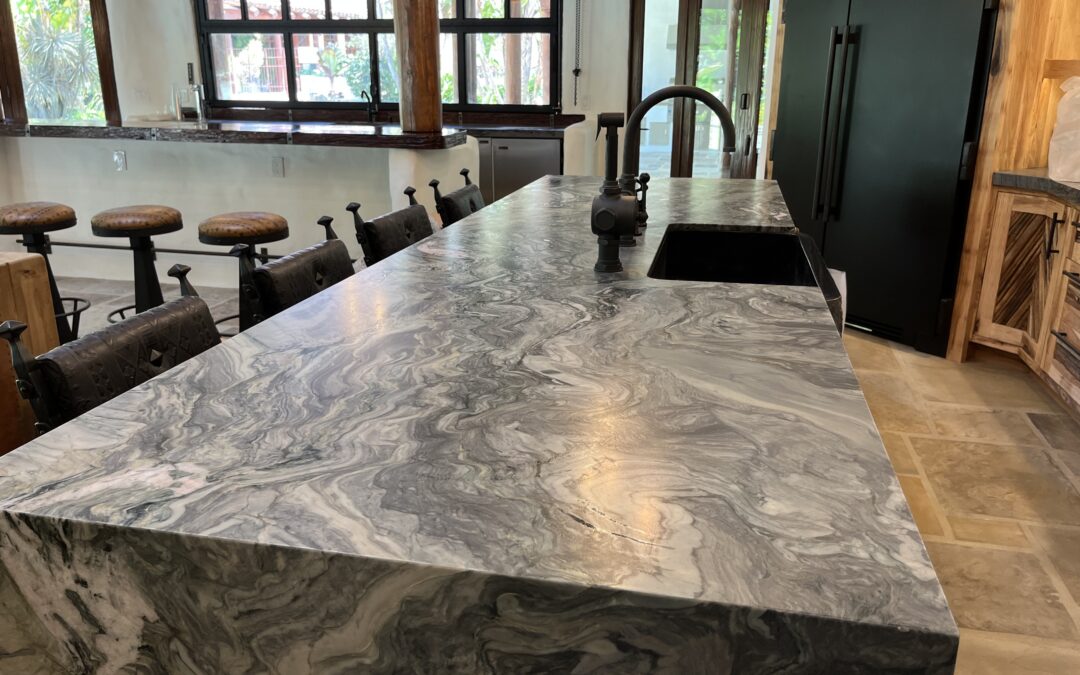
Natural stone countertops are one of the most requested materials in our Anaheim showroom. Granite, quartzite, and marble are the three most common choices, and they look similar in small samples but perform very differently over time in a working kitchen. Understanding those differences before you select your slab is the most important thing you can do to make sure you end up with a surface that works for how you actually use your kitchen.
What Granite, Quartzite, and Marble Actually Are
All three are natural stone formed through geological processes, which is why they share a visual quality that engineered surfaces like quartz cannot replicate. But the processes that form them are different, and those differences explain why each one behaves the way it does in a kitchen.
Granite is an igneous rock formed from the slow cooling of magma deep in the earth. Its interlocking mineral crystal structure, primarily feldspar, quartz, and mica, gives it exceptional hardness and makes it one of the densest and least porous natural stones available.
Quartzite starts as sandstone. When quartz-rich sandstone is subjected to intense heat and pressure during mountain-building events, the grains recrystallize into quartzite, a network of interlocking quartz crystals with exceptional strength. According to the U.S. Geological Survey, quartzite ranks around seven on the Mohs hardness scale, making it harder than most natural stones used for countertops.
Marble is a metamorphic rock formed when limestone is subjected to heat and pressure. Its calcite composition gives it the luminous, light-transmitting quality that makes it visually distinctive, but that same calcite makes it softer and more reactive to acids than granite or quartzite.
How Each Stone Performs in a Kitchen
Granite is well-suited for kitchen countertops because it resists heat, scratching, and staining better than most natural surfaces. A hot pan placed directly on granite will not damage the surface the way it might with engineered surfaces that contain resins. Granite does require sealing every one to three years to prevent staining from oils and liquids, but the maintenance is straightforward. For Orange County households where the kitchen sees consistent daily use, granite is one of the most practical natural stone choices.
Quartzite outperforms granite in one key area: it resists etching from acidic substances. In Southern California kitchens where lemon juice, tomatoes, and wine are common, the difference between quartzite and marble matters. Quartzite also tends to have a more dramatic, marble-like appearance with strong veining, which is why many homeowners who want the visual quality of marble choose quartzite instead for the added durability. It still requires sealing every one to two years but is less reactive than marble or limestone.
Marble is the most visually distinctive natural stone and the most demanding in a kitchen. Its calcite composition means it etches when it contacts acidic substances like citrus juice, wine, or vinegar. Those etch marks appear as dull patches in the surface where the acid has dissolved a fine layer of the stone. Over time marble develops a patina, a lived-in character that many homeowners love and others find frustrating. For anyone who wants a pristine surface that looks the same in year ten as it did on installation day, marble is probably not the right kitchen countertop material. For homeowners who find the natural aging process appealing, marble in a kitchen can be genuinely beautiful.
The Slab Selection Decision
The most important thing to know about natural stone is that samples do not tell the full story. Color, veining intensity, background tone, and surface movement vary significantly from slab to slab, even within the same material batch from the same quarry. A four-inch sample chip may look dramatically different from the actual slab that gets fabricated into your countertop.
At our Anaheim showroom, we carry standing slabs of granite, quartzite, and marble for in-person viewing. Seeing the full slab under showroom lighting, next to your cabinet door sample and flooring material, is the only reliable way to confirm the stone will work in your specific kitchen before the fabrication process begins. This is the reason slab yards and tile showrooms on State College Boulevard exist: because this is a decision that needs to be made in person.
Which One Is Right for Your Orange County Kitchen
Here is the straightforward guidance we give homeowners who ask:
If your kitchen sees heavy daily use, children, frequent cooking, and you want a surface that requires minimal attention: choose granite. It handles the real conditions of a working kitchen better than marble and costs less than most quartzite.
If you want the dramatic veining and visual quality of marble but need a surface that holds up better to acids: choose quartzite. The maintenance difference between quartzite and marble is significant in a kitchen environment, and the appearance can be nearly indistinguishable to most eyes.
If appearance is the primary priority and you are willing to accept that the surface will develop character over time: marble can work in a kitchen, particularly in a household where the cooking style is careful or the kitchen is used less intensively than average.
City Tile & Cabinets has been fabricating and installing natural stone countertops in Anaheim and throughout Orange County since 1998. Our team can walk you through the specific slab options currently in stock, explain how each one will perform in your kitchen, and help you make a selection before fabrication begins. Visit our showroom at 1535 S State College Blvd on Tile Row or call us to schedule a slab viewing appointment.